Every accountant learns the three financial statements: the Income Statement, the Balance Sheet, and the Cash Flow Statement. They are the standard map of a business.
But the map is not the territory.
The traditional statements show what happened — backward-looking, monthly at best, formatted for compliance rather than comprehension. For a small business owner making decisions this week, they’re the wrong map. Precise, authoritative, and quietly useless.
The Fourth Statement is the missing view: dynamic, forward-looking, built around what actually drives the business. It doesn’t replace the three statements — it sits on top of them and gives them meaning.
A Map from the Time of Columbus
The traditional three-statement model was first documented by Luca Pacioli, a mathematician in Venice, in 1494 — over five hundred years ago. The map we use for business was invented when most people believed the world was flat.
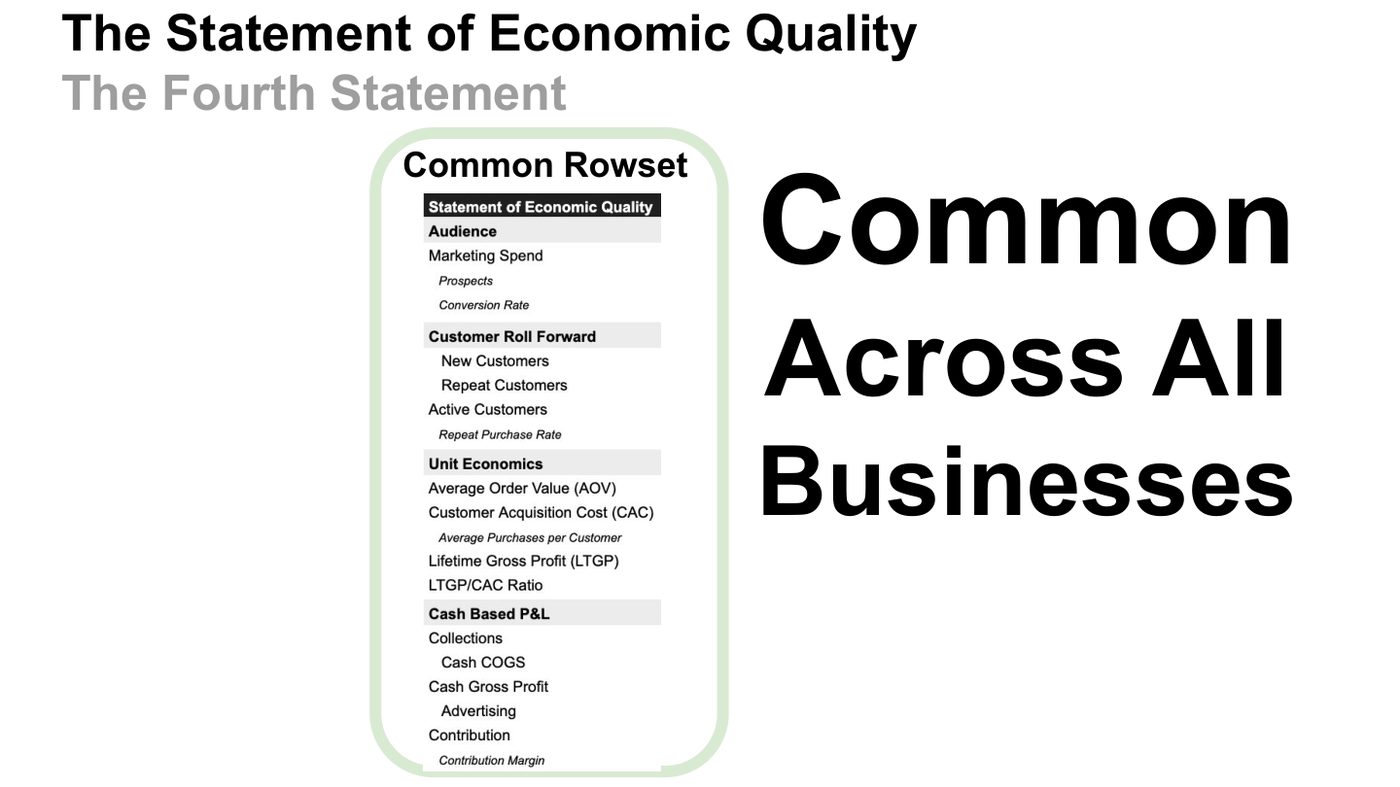
The Fourth Statement asks four questions — one per section — alongside the three that already existed.
The Four Questions
- Income Statement — Were we profitable or unprofitable over a period of time?
- Balance Sheet — Where are all of our assets and liabilities at this point in time?
- Cash Flow Statement — Where did the cash come from and where did it go?
- Statement of Economic Quality — Are the underlying economics of the business healthy?
The Four Sections
- Audience — every company has a potential audience, its addressable market. Each period, the company spends money to get exposed to a portion of it.
- Customer Roll Forward — through marketing and sales funnels, a company converts audience into new customers and tries to keep them coming back.
- Unit Economics — compares customer acquisition costs to the lifetime gross profit each customer is expected to generate. Sampled weekly, monthly, quarterly, and cumulatively.
- Direct Cash — cash through the lens of a Direct Cash Flow Statement. Starts with collections, ends with change in cash, no accrual adjustments. Like looking at your own checkbook. This is why the books can close every week.
What Makes It Different
- It blends history and forecast in one view. The line between “what happened” and “what we expect” moves forward every week as new actuals arrive.
- It’s built around drivers, not categories. Customers, orders, conversion, average order value, acquisition cost — the levers an owner actually pulls. Revenue is an output of those drivers, not a line you guess at.
- It runs on a weekly rhythm. Businesses live week to week. A monthly close that arrives three weeks late is archaeology, not navigation.
The Components
- The IFM (Integrated Financial Model) — the implementation vehicle: one connected model holding the statements, the drivers, and the forecast
- The SEQ (Statement of Economic Quality) — the layer that instruments what drives this specific business
- The Contribution Engine — unit economics: what each customer contributes and what growth actually costs
- BKQA (Bookkeeping Quality) — the foundation: none of it works if the books are wrong
The Right Data 2x2
When you put the right data in front of an empowered team, they get better.
You can try it other ways, but it won’t work. Wrong data in front of an empowered team just frustrates them. Right data in front of a disempowered team is sad. The Fourth Statement is one half of the equation — the right data. The weekly CFO session is the other half — the empowered team.
The Underlying Idea
See Signal vs Noise — the Fourth Statement exists because most financial reporting buries the signal a business owner needs under conventions built for someone else.