The system that became Weekly Accounting was developed over nearly thirty years across five companies and a fund. Two threads converged.
Thread 1 — The Framework
Starting in the late 1990s, the same kind of financial model got built at a succession of companies — one that went beyond GAAP statements to instrument the revenue engine and unit economics. Over time, the model became standardized. The insight at the center:
Every business has an audience it tries to convert into paying customers, then tries to keep them coming back.
That’s the Contribution Engine.
Thread 2 — The Data
Before Weekly Accounting, the same team built a specialty fund for emerging consumer brands. Pulling data from QuickBooks and Shopify across about 150 companies and building unit economic analyses of each revealed a “credit box” — patterns in the data that predicted which businesses would thrive.
The same platform that powered that analysis became the basis for Weekly Accounting.
After looking at the financials of thousands of emerging consumer brands, two things became clear: how poorly accountants and bookkeepers serve small businesses, and how big the opportunity was to help.
A Map from the Time of Columbus
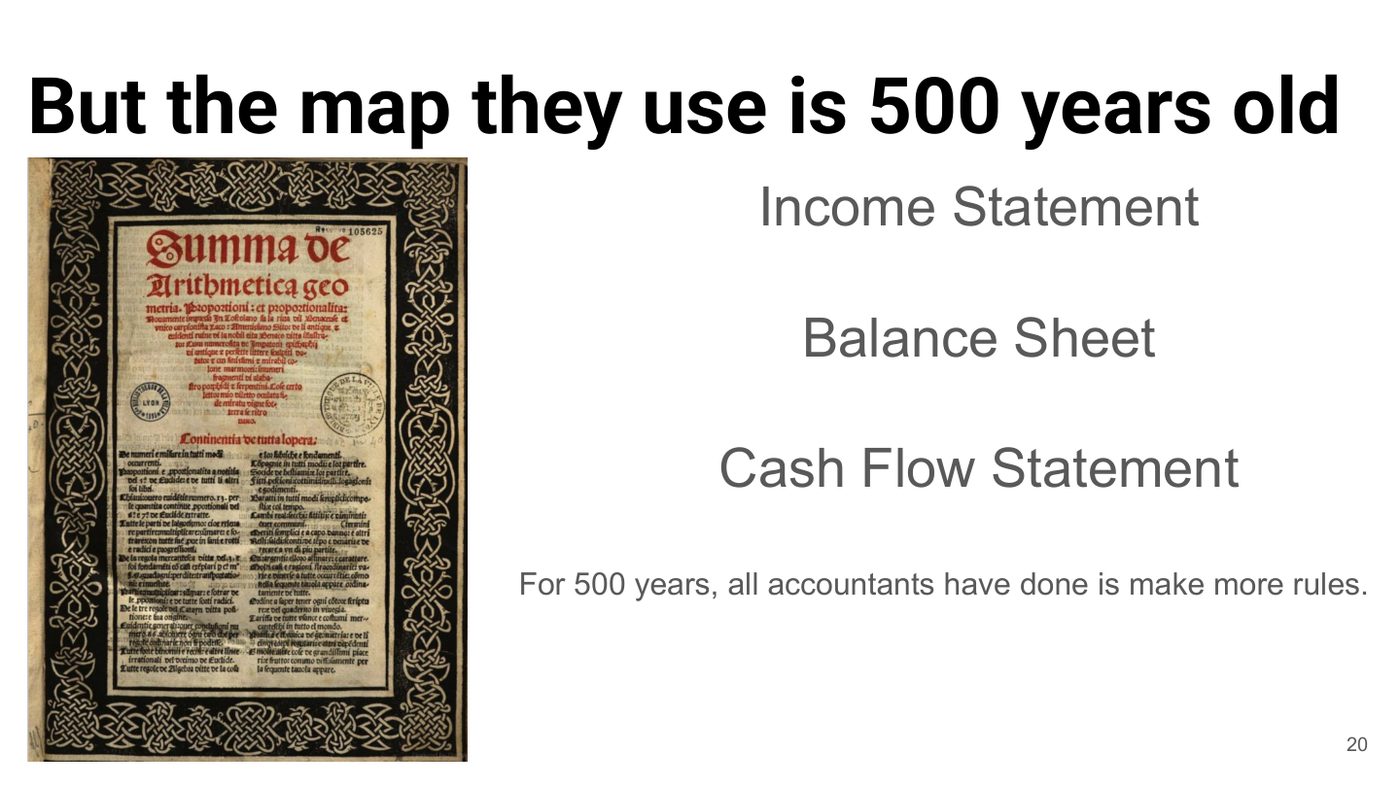
The three financial statements everyone uses — Income Statement, Balance Sheet, Cash Flow Statement — were first documented by a mathematician named Luca Pacioli in Venice in 1494. Over five hundred years ago. The map we use for business was invented when most people believed the world was flat.
For 500 years, all accountants have done is make more rules.
The Fourth Statement is a new map.
The System
Weekly Accounting works in four steps:
- Connect — a business connects its applications (accounting, commerce, payments)
- Integrate — all data flows into a single weekly data warehouse
- Build — the team builds the Perfect Rowset, focused on the revenue engine and unit economics, not just the income statement and balance sheet
- Facilitate — weekly sessions help the founder use the system to see the business better
The weekly rhythm — the Monday Morning Metrics — delivers 52 feedback loops per year instead of 12. Because businesses live week to week. A monthly close that arrives three weeks late is archaeology, not navigation.
The Big Vision
To help everyone see their business better.
Manage Your Business Weekly, Not Weakly.
The Gift
Every relationship starts with a complimentary analysis — an Initial Business Review from an experienced CFO, built on an IFM. A founder connects their books; the system ingests the data; during the review, the CFO evaluates bookkeeping quality, customer acquisition cost, lifetime value, and opportunities. No commitment required. We call it The Gift.
Zero CPAs by Design
A CPA is a license to do your books in a way that doesn’t help the business.
That’s because the intention of compliance accounting is to make sure you follow rules set by tax collectors and regulatory agencies. We start with a different intention: to help you see your business better.
From Zen and the Art of [nothing] by John Zdanowski & Jeff Abrams, Chapter 14.